
Behind Tabis
A shoe that has the power to divide a nation. The more you know the harder it is not to convert into the cult of the Tabi. For my first post, I wanted to lay it out in my own words.

The infamous Tabi shoes by Maison Martin Margiela are one of those things that you come across once and all of a sudden, you see them everywhere. At first, it’s hard to understand why someone would want to sport a camel toe on their actual toes, but every step you see them take feels more like something you can get behind. So what’s the big idea? The Pinterest girls love to stick a cigarette or glass of wine between their toes, post a picture and call it a day. But of course, there’s more to it than that.
The Margiela Tabi boot completed every look of the Maison’s very first runway for Spring Summer 1989. In the 2019 documentary, “Martin Margiela: In His Own Words”, he described a shoe as one of the two most important details in fashion, explaining their value in giving the wearer “a certain movement” critical to the presentation of the clothes themselves. As his garments were being presented to the public eye for the first time, Martin Margiela wanted a shoe that could be invisible, something that could carry but not draw away from his first collection. Every detail of the SS89 show changed the game, including the flood that closed it. With the models all dressed in white lab coats, it was time for the shoes to make their statement. Each boot was drenched in red paint and left stains on the white canvas runway, cementing the Margiela footprint in fashion history. (Discussing this show is like opening a can of worms, for example, it was impossible for me not to mention the waistcoat constructed of this very canvas which opened the following show. There are a million things I had to edit out for going beyond the scope of this article so I would love to write more or recommend further reading about Margiela’s first shows if you are interested).
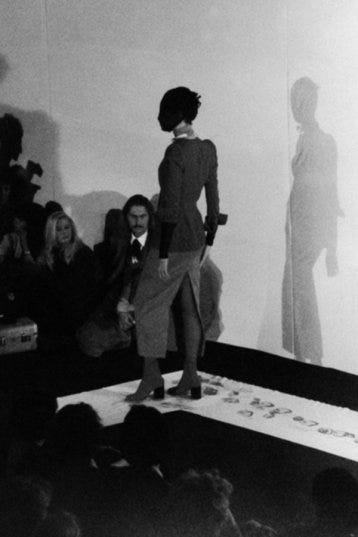
Maison Martin Margiela Spring/Summer 1989
The same pairs of Tabi boots were recycled in follow-up shows and reimagined in some years with wall paint in red, white and silver wall. The hand paintings would chip off, creating a signature crackling effect on the leather. The reuse is attributed to budgetary restraints, but show after show it was clear that they weren’t going anywhere. The peak of this was in Spring Summer 1996, when just the heeled sole of the shoe was stuck to the model’s feet with clear tape. The first purchased pair of Tabi boots was months before the first show, but they weren’t available to the public until 1992, after several seasons, much begging, and pleading. The boot would evolve into a myriad of shapes (mary janes, loafers, ankle strap ballerinas, ballerinas, knee-highs, sandals, clogs, sneakers), flat varieties, glove varieties, and an exploration of materials and colour treatments. The “Topless Tabi” rendition can also be purchased, complete with a roll of tape.
It seems that something in the split toe has given the shoe a grip strength that holds our interest hostage. The idea did not come from Margiela himself, so they must have had the same effect on him when he first saw them during a trip to Tokyo. The Tabi style has a long-standing history that dates back to the introduction of Indian cotton in Japan in the 15th century. The split toe was not only a solution for thonged Zori and Geta sandals but offered benefits for the feet, posture, and stability. In the 20th century, the sock evolved to the Jika-Tabi, featuring a rubber sole that allowed it to be worn directly on the ground. It became customary for workers who stand for long periods to wear them, which is how Margiela was introduced to the idea. Although it wasn’t easy to find a cobbler who dared to create such a radically unfamiliar shoe, Margiela quite literally elevated the Tabi sock (to a high heel…). Perhaps this is the greatest example of Margiela’s trailblazing mastery of reimagining historical garments.
While the split toe may be the standout design element of the shoe, every other detail offers its own epitome of the core of Maison Margiela. His goal was to create something to empower real women, with a beauty that isn’t preconceived and can’t be described on paper. Margiela recognised that the stilettos and pumps of the time were an impractical and uncomfortable imposition of male designers on women. The solution was a heel that maintained the diameter of the foot, not only offering balance and comfort but freeing the walk to follow the body’s natural movement. The rest of the design, Margiela admitted in an interview that accompanied a MOMU Antwerp exhibition from 2015, was based on “academic” inspiration. At a time when women’s Ready-to-Wear was chock-full of colour, pattern and the seasonal output of new themes, the Maison introduced an alternative: an unprecedented form of authentic minimalism. In the Tabi boot this was realised through “ancient principles of masculine dress”. The chosen leather and construction of the shoe, being chunky from the side but narrow when viewed from the front, was traditionally masculine. Margiela’s models were women scouted from the street and sent out on the runway without direction, solidifying this vision of unfeigned and candid sexiness seen nowhere else in fashion until this point.
With just a gap between two toes, the Tabi boot played a monumental role in filling a century-old gap in high fashion. They weren’t just an idea plucked in the hopes of satisfying our addiction to novelty for a season or two, they were a gift to women who had long been denied their natural beauty in the name of perfection. Maison Margiela’s first collections complete with re-re-reused Tabi boots antagonised critics, but those who didn’t walk into each show already hating what they were about to see, were captivated. Over 35 years later, in the context of an entirely evolved world of fashion, it may not make sense to the unknowing eye what such a strange shoe has done to earn its enthralled cult following. The way they are still able to draw reactions, curiosity and connections between strangers demonstrates how fundamentally, their revolution is still being instigated today. In all its forms, the shoe has never stopped pushing the boundaries of our beauty ideals and you don’t have to know their history to feel this effect. But now you do. :)
References / Read Further:
Bliss Foster’s “How to Learn Everything About Margiela” Part 1 and 2 on Youtube
@margielatab1 on Instagram
Documentary on Martin Margiela:
https://sales.dogwoof.com/margielainhisownwords
https://www.thecut.com/2019/11/fashion-critic-cathy-horyn-on-margiela-in-his-own-words.html
More about Margiela:
https://graduatestore.fr/blog/en/martin-margiela-the-invisible-man/
https://www.tributetomagazine.com/the-historic-maison-martin-margiela-1989-fashion-show-and-its-influence-on-todays-fashion-industry/
https://www.nytimes.com/interactive/2017/02/06/t-magazine/jenny-meirens-margiela-interview.html
Articles on the Tabi:
https://www.ssense.com/en-us/editorial/fashion/the-uncanny-appeal-of-margielas-tabi-boots
https://www.harpersbazaar.com/uk/fashion/a43561450/margiela-tabi/
https://www.milanesiamilano.com/post/the-long-history-of-tabis
https://www.dazeddigital.com/fashion/article/35736/1/the-instagram-documenting-the-margiela-tabi-boots-28-year-reign-margielatab1
https://akaibu.co/blogs/fashion-articles/history-of-the-tabi
https://www.kineyatabi.com/discover-1/health-benefits/
https://www.tabio.fr/en/blogs/le-magazine/15-les-bienfaits-des-chaussettes-tabi-sur-la-sante/
https://www.anothermag.com/fashion-beauty/7721/the-tale-of-margielas-tabi-boot